

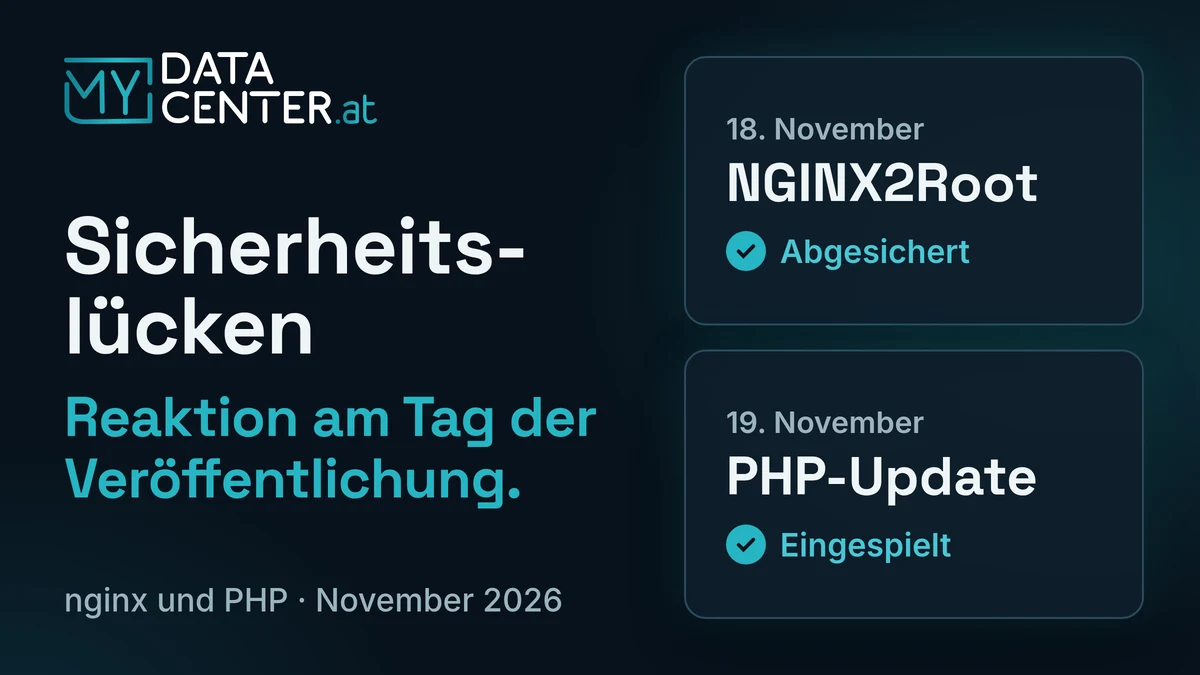
In mid-November, security vulnerabilities in two core building blocks of the internet became public within two days: on 18 November the “NGINX2Root” series of vulnerabilities in the nginx web server, and on 19 November a security update for the PHP programming language. In both cases, we acted on the day of publication. Your services kept running without any planned interruption.
How we handle security vulnerabilities
Our monitoring records which software versions run on which systems. When a vulnerability becomes public, we therefore know quickly which systems are affected. After that, we always follow the same steps:
- Assess. Based on the vendor’s information, we check how severe the vulnerability is and under which conditions it can be exploited.
- Secure. If no fix is available yet, we temporarily close the attack path, for example by disabling the affected feature. If necessary, we also take a system offline.
- Update. As soon as fixed packages are released, we install them.
- Verify. We restart the affected services and check on every system that no process is still running the old version.
18 November: NGINX2Root
On 18 November, security researchers published five vulnerabilities in the nginx web server under the name “NGINX2Root”. One of them allows attackers to run their own code on the server without logging in, provided the HTTP/2 protocol is enabled. The researchers recommended disabling HTTP/2 until the update.
That is exactly what we did the same day between 17:05 and 17:20, on all production nginx servers where HTTP/2 was still enabled. Since then, neither our website nor the customer portal nor the webmail interface of Managed Zimbra has used HTTP/2. On the website, we also disabled HTTP/3, which is affected by another of the five vulnerabilities. Nothing changed for you: your browser has since connected via HTTP/1.1.
The website and our console server now run the fixed nginx version from Debian. For the remaining systems, we will install the fix as soon as their vendors ship it. Until then, the protective measures stay in place.
19 November: PHP security update
The PHP project had announced security updates for all supported versions for 19 November, scheduled between 15:00 and 15:30 Austrian time. The highest severity was “critical”. According to the PHP project, the critical issues only apply to non-default configurations or uncommon setups. The fixed versions 8.5.13, 8.4.28, 8.3.37 and 8.2.36 were released.
We installed the update as soon as the packages were available:
- 16:04: website on PHP 8.4.28
- 16:09: customer portal on PHP 8.3.37
- 16:24 to 16:37: all websites of our web hosting customers on PHP 8.4.28 or 8.3.37
Our web hosting customers did not have to do anything. Each website was only restarted briefly.
In October, we took our website and customer portal offline for several hours because of the “PHP2Shell” vulnerability until the fix was available (read the post). This time that was not warranted, because the PHP project assessed the situation differently. We decide on the right step each time.
Do you run nginx or PHP on your own server with us?
You manage your cloud servers yourself; we do not access them. So please check whether you need to update:
- nginx: The fixed versions are 1.30.7 and 1.31.9. Debian 12 and Debian 13 ship the fix through their security updates. Until you update, disabling HTTP/2 closes two of the five vulnerabilities, including the one described above.
- PHP: Safe versions are 8.5.13, 8.4.28, 8.3.37, 8.2.36 or later. Debian 12 and Debian 13 ship the fix here as well. PHP 8.1 and older no longer receive fixes from the PHP project.
- Restart: Running processes keep using the old code. After the update, restart nginx and the PHP service (
php-fpm).
Some distributions backport fixes into older version numbers. In that case, the package changelog shows whether the fix is included, not the version number.
If you would like help with the update, contact our support. If you would rather not deal with updates like this at all, we take care of it as part of our managed services. With our web hosting, this is included anyway.